# Array
## **Notes**
* Two/Three-way partition for an array. They are common techniques used in quicksort, Dutch national flag problem, and other array manipulation problems.
// Two-way partition
  // it divides the array into 2 parts
  // elements < pivot and >= pivot (or elements <= pivot and >= > pivot),
  // making it simple but inefficient for duplicate values.
  private int[] twoWaysPartition(int[] nums, int left, int right) {
      int pivot = nums[right];
      int i = left;
      for (int j = left; j < right; j++) {
          if (nums[j] < pivot) {
              swap(nums, i, j);
              i++;
          }
      }
      swap(nums, i, right);
      return i;
  }

  // Three-way partition (AKA Dutch National Flag Problem => LC 75)
  // it further splits the array into 3 parts
  // element < pivot, == pivot, and > pivot,
  // reducing redundant swaps and improving QuickSort efficiency, especially when duplicates are common.
  private int[] threeWayspartition(int[] nums, int left, int right) {
      int pivot = nums[right];
      int i = left;
      int j = left;
      int k = right;
      while (j <= k) {
          if (nums[j] < pivot) {
              swap(nums, i, j);
              i++;
              j++;
          } else if (nums[j] > pivot) {
              swap(nums, j, k);
              k--;
          } else {
              j++;
          }
      }
      return new int[]{i,k};
  }
* For an array of length n, the number of subarrays = $$1 + 2 + ... + n = n \* (n + 1) / 2$$
* Reason: fixing right end r (from 1 to n), there are r choices for the left end
## **Typical Questions**
### **Matrix**
* :orange\_circle: LC 59. Spiral Matrix II
* LC solution is easier than 代码随想录, There are 4 vars representing the 4 boundaries and they keep approaching the center as the traversal
* LC 54. Spiral Matrix
* Similar as above
* [Optimal Answer](https://leetcode.com/problems/spiral-matrix/submissions/1495629711). TC: $$O(m\*n)$$, SC: $$O(1)$$
* :orange\_circle: LC 2018. Check if Word Can Be Placed In Crossword
* It's kind of hard to implement with a clear thought
* [Optimal Solution](https://leetcode.com/problems/check-if-word-can-be-placed-in-crossword/submissions/1485698943)
* Let $$m$$ be the length of rows, $$n$$ be the length of columns, $$k$$ be the length of the word
* TC: $$O(m*n*k)$$
* SC: $$O(1)$$
* LC 48. Rotate Image
* It's very tricky (The second time I ran into this problem, I figured it out myself!)
* [Optimal Answer](https://leetcode.com/problems/rotate-image/submissions/1495549248). TC: $$O(n^2)$$, SC: $$O(1)$$
* :white\_circle: LC 36. Valid Sudoku
* It's challenging to come up with a solution with 1 pass.
* [Optimal Answer](https://leetcode.com/problems/valid-sudoku/submissions/1782852101). TC: $$O(1)$$, SC: $$O(1)$$
* :white\_circle: LC 73. Set Matrix Zeroes
* It's challenging to come up with a solution that uses constant space.
* [Optimal Answer](https://leetcode.com/problems/set-matrix-zeroes/submissions/1783840794). TC: $$O(m\*n)$$, SC: $$O(1)$$
* LC 289. Game of Life
* It's challenging to come up with a solution that uses constant space. (I made it the first time I saw this problem!)
* [Optimal Answer](https://leetcode.com/problems/game-of-life/submissions/1784560914). TC: $$O(m\*n)$$, SC: $$O(1)$$
* :white\_circle: LC 498. Diagonal Traverse
* Try to do it without a boolean variable.
* [Optimal Answer](https://leetcode.com/problems/diagonal-traverse/submissions/1883427909). TC: $$O(m\*n)$$, SC : $$O(1)$$
* :orange\_circle: LC 723. Candy Crush
* Easy to misunderstand problem statement on when a candy can be crushed.
* [Optimal Answer](https://leetcode.com/problems/candy-crush/submissions/1888257445). TC: $$O(m^2\*n^2)$$, SC: $$O(n)$$
* LC 1304. Find N Unique Integers Sum up to Zero
* [Optimal Answer](https://leetcode.com/problems/find-n-unique-integers-sum-up-to-zero/submissions/1939380125). TC: $$O(n)$$, SC: $$O(1)$$
* LC 840. Magic Squares In Grid
* [Optimal Answer](https://leetcode.com/problems/magic-squares-in-grid/submissions/1962489243). TC: $$O(m\*n)$$, SC: $$O(1)$$
### **Boyer-Moore Voting Algorithm**
* :red\_circle: LC 169. Majority Element
* I can't come up with this optimal solution without knowing/remembering this specific algorithm. This algorithm only works under the assumption that a majority element is guaranteed.
* Remember this question is about finding the number which appears⌊n / 2⌋ times, but **NOT** the number with the highest frequency (mode).
* [Optimal Answer](https://leetcode.com/problems/majority-element/submissions/1477353262). TC: $$O(n)$$, SC: $$O(1)$$
### Sorting Algorithm
* :star2: LC 215. Kth Largest Element in an Array
* :orange\_circle: [Counting Sort Solution](https://leetcode.com/problems/kth-largest-element-in-an-array/submissions/1468838317).
* TC: $$O(n+m)$$, where $$n$$ is the length of `nums` and $$m$$ is `maxValue - minValue`
* SC: $$O(m)$$, $$m$$ is `maxValue - minValue`
* :orange\_circle: [QuickSelect Solution](https://leetcode.com/problems/kth-largest-element-in-an-array/submissions/1558635028). TC: $$O(n)$$, SC: $$O(1)$$
* [Quickselect](https://en.wikipedia.org/wiki/Quickselect), also known as **Hoare's selection algorithm**, is an algorithm for finding the $$k\_{th}$$ smallest element in an unordered list. It is significant because it has an **average** runtime of $$O(n)$$.
* Using the two-way partition in QuickSelect will cause TLE due to too many duplicates in some test cases, so use the three-way partition instead.
* [MinHeap Solution](https://leetcode.com/problems/kth-largest-element-in-an-array/submissions/1468831794). TC: $$O(n\*log{k})$$, SC: $$O(k)$$
* LC 274. H-Index
* We scan citation counts from highest to lowest and keep a running total of how many papers have at least that many citations. The H-index is the first value 𝑐 for which the accumulated paper count is greater than or equal to 𝑐.
* Approach 1 with normal sorting: [Answer](https://leetcode.com/problems/h-index/submissions/1766592357). TC: $$O(n\*logn)$$, SC: $$O(n)$$
* :thumbsup: :red\_circle: Approach 2 with Counting Sort: [Optimal Answer](https://leetcode.com/problems/h-index/submissions/1855709734). TC: $$O(n)$$, SC: $$O(n)$$
* It's tough to understand...
* 2 ideas by scanning citation counts (`c`) from highest to lowest and keep a running total of how many papers (`papers`) have at least that many citations
* :x: 1. Use `papers`: Find the last `papers` which `papers` < c. This can be a result candidate, but may not be the best result. For example, if the input is \[3, 2, 2], this idea will return 1 as a result, but the real result is 2.
* :white\_check\_mark: 2. Use `c`: Find the first `c` which `papers` ≥ `c`. C-based method works because `c` is exactly the value that must satisfy the H-index definition. `papers` is only used to verify it, not to produce the H-index value.
### **DNF algorithm**
* :orange\_circle: LC 75. Sort Colors
* **DNF algorithm (Dutch national flag problem)**. Read the detailed explanation of the optimal solution
* Update: Move this question from Two Pointers section to Array section because I find it relates to the Three-way partition used in the QuickSelect algorithm.
* [Optimal Solution](https://leetcode.com/problems/sort-colors/submissions/1485004939). TC: $$O(n)$$, SC: $$O(1)$$
### **Other Array Questions**
* LC 1431. Kids With the Greatest Number of Candies
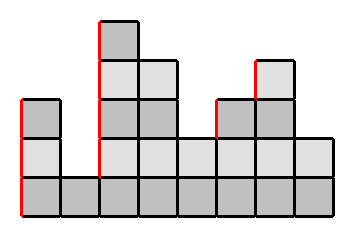
* :orange\_circle: LC 1526. Minimum Number of Increments on Subarrays to Form a Target Array
* After thinking array as a list of height values, it's easy to resolve.
* [Optimal Answer](https://leetcode.com/problems/minimum-number-of-increments-on-subarrays-to-form-a-target-array/submissions/1474827964). TC: $$O(n)$$, SC: $$O(1)$$
* :white\_circle: LC 189. Rotate Array
* Be careful for the corner case (what if k is very large).
* [Optimal Answer](https://leetcode.com/problems/rotate-array/submissions/1486719102). TC: $$O(n)$$, SC: $$O(1)$$
* :orange\_circle: LC 41. First Missing Positive
* It's hard to resolve it in TC $$O(n)$$, SC: $$O(1)$$. The key idea is to reuse the original array as a map.
* [Optimal Answer](https://leetcode.com/problems/first-missing-positive/submissions/1494537924)
* TC: $$O(n)$$, **the inner `while` loop across all iterations of the outer loop is O(n).**
* SC: $$O(1)$$
* LC 485. Max Consecutive Ones
* [Optimal Answer](https://leetcode.com/problems/max-consecutive-ones/submissions/1542263025). TC: $$O(n)$$, SC: $$O(n)$$
* LC 3151. Special Array I
* [Optimal Answer](https://leetcode.com/problems/special-array-i/submissions/1555641292). TC: $$O(n)$$, SC: $$O(1)$$
* :white\_circle: LC 251. Flatten 2D Vector
* [Optimal Answer](https://leetcode.com/problems/flatten-2d-vector/submissions/1597923049).
* Let $$N$$ be the number of integers and $$V$$ be the number of cells (some could be empty) of the input
* TC:
* Constructor: $$O(1)$$
* `next()`, `hasNext()` : $$O(V/N)$$
* SC: $$O(1)$$
* LC 3201. Find the Maximum Length of Valid Subsequence I
* [Optimal answer](https://leetcode.com/problems/find-the-maximum-length-of-valid-subsequence-i/submissions). TC: $$O(n)$$, SC: $$O(1)$$
* :red\_circle: LC 3480. Maximize Subarrays After Removing One Conflicting Pair
* This is too hard. No idea or even a clue at all.
* Check this [solution](https://leetcode.com/problems/maximize-subarrays-after-removing-one-conflicting-pair/solutions/7005474/maximize-subarrays-a-single-pass-on-solu-11eq) to understand it.
* [Optimal Answer](https://leetcode.com/problems/maximize-subarrays-after-removing-one-conflicting-pair/submissions/1890596485).
* Let $$N$$ be the input integer and $$P$$ be the number of conflicting pairs.
* TC: $$O(N+P)$$, SC: $$O(N)$$
* LC 1762. Buildings With an Ocean View
* [Optimal Answer](https://leetcode.com/problems/buildings-with-an-ocean-view/submissions/1898289650). TC: $$O(N)$$, SC: $$O(N)$$
* :white\_circle: LC 3349. Adjacent Increasing Subarrays Detection I
* [Optimal Answer](https://leetcode.com/problems/adjacent-increasing-subarrays-detection-i/submissions/1951689039). TC: $$O(N)$$, SC: $$O(1)$$
### Simulation
* :white\_circle: LC 755. Pour Water
* [Optimal Answer](https://leetcode.com/problems/pour-water/submissions/1606047834). TC: $$O(n\*v)$$, SC: $$O(1)$$
* LC 1929. Concatenation of Array
* [Optimal Answer](https://leetcode.com/problems/concatenation-of-array/submissions/1952647217). TC: $$O(n)$$, SC: $$O(1)$$